

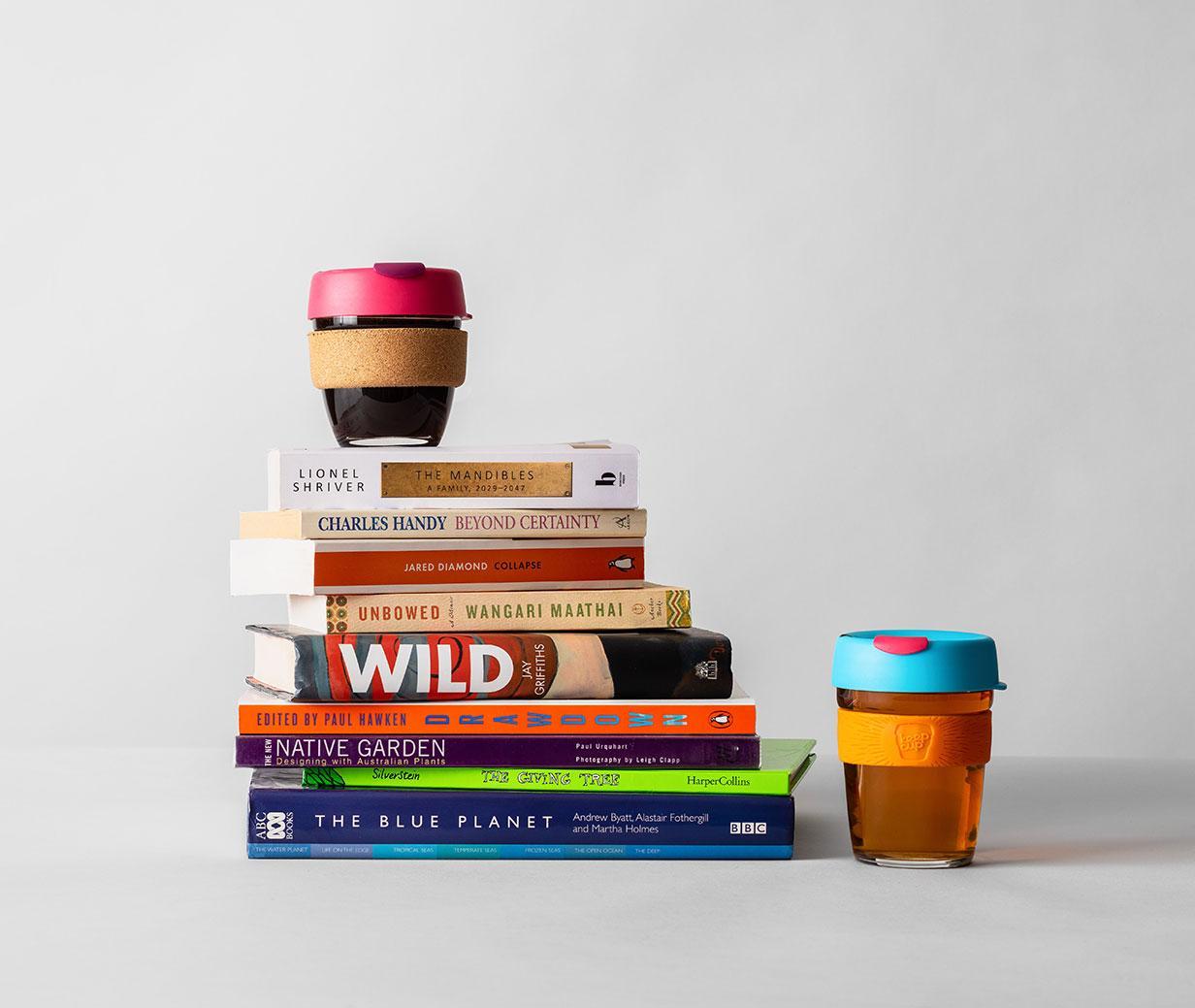
KeepCup has spent over fifteen years building reusable products, advocating for system change, and trying to be honest about what works and what doesn't. The next decade matters more than the last one. Here's what we hope to do, what we hope to see, and what we think the years ahead need from businesses like ours.
Where KeepCup Wants to Be
One. A KeepCup Product in Every Australian Kitchen
Not in a market-share sense — in a behaviour-change sense. Our ambition is that the default reusable drinkware in Australian homes is high-quality, modular, repairable, and made to last. KeepCup, ideally. Other strong competitors, also fine. The shape of the market matters more than our share of it.
The metric we'd actually like to be measured against is the reduction in Australian disposable cup, bottle and bowl consumption. The path involves more KeepCups in circulation, more reusable culture in cafés, and structural changes to how Australian food service operates.
Two. Less New-Plastic in Our Products
Our products use recycled content where possible, and we continue to push that share higher across the range. Our long-term direction is to design out new-plastic content except where regulatory or safety requirements specifically require it.
The path is two-fold: continued investment in our own product recycling streams, and supplier-side investment in higher-quality recycled material that performs equivalently to virgin. KeepCup products are tested to 1,000 uses — the longest-lasting product is the lowest per-use plastic footprint.
Three. Closed-Loop Returns
We want any KeepCup product to be returnable to KeepCup at end-of-life for direct reuse of components or full material recovery. The replacement parts ecosystem already extends product life. A takeback program closes the remaining loop.
Building this requires logistics infrastructure we don't currently have at scale. We've started the work.
Four. Manufacturing in More Countries
KeepCup currently manufactures predominantly in Australia, with limited operations in the UK. Shipping reusable products across hemispheres is environmentally suboptimal. We want local manufacturing in more regions over time — North America, EU, and ideally a South or East Asian hub. Local manufacturing closes the transport emission gap and supports local economies.
The challenge is matching quality standards across distributed manufacturing. The opportunity is reducing per-unit logistics emissions and supporting local supply chains.
Five. Sustained B Corp Best for the World Status
We've been Best for the World multiple times. We'd like to be there every recertification cycle. The honour is the floor we're trying to keep clearing, not the ceiling we're aiming for.
What We Hope to See From Australian Policy
Five policy reforms that would make the next decade dramatically more productive:
- National single-use plastic framework. Harmonise state-level bans into a federal framework. Reduce compliance complexity for manufacturers and improve enforcement effectiveness.
- Container deposit expansion. Include disposable coffee cups in container deposit schemes. Create the price signal that disposables have avoided.
- Extended producer responsibility for packaging. Make manufacturers responsible for end-of-life of their packaging. The strongest single lever for packaging reduction.
- Mandatory climate-aligned procurement. Government procurement is one of the largest single buyers in any economy. Climate-aligned procurement standards would shift supplier behaviour across the board.
- Right to repair legislation. Strengthen the legal right to repair products — from drinkware to electronics. The repair right is the strongest support for circular product design.
What We Hope to See From Customers
The customer side of the equation is less about hoping and more about hosting good options. The shifts we'd like to see, recognising they require the products to be available and accessible:
- Permanent carry of reusables becomes default rather than exceptional.
- Repair rather than replace becomes the first instinct when a product component fails.
- BYO becomes the standard rather than the request at Australian cafés.
- Demand for genuinely circular products outpaces demand for products with sustainability marketing.
- Voting and consumer choice align with stated values across more Australian households.
None of this is asking customers to be heroes. It's asking the system to make the sustainable choice the easy choice. Our job as a manufacturer is to make products that support that. Policy's job is to align the incentives.
What We Hope to See From Other Businesses
Three asks of fellow Australian businesses, particularly other B Corps and aspirational ones:
Tell the Truth About Trade-Offs
Sustainability involves trade-offs. Lower-impact materials can be more expensive. Local manufacturing can be slower. Circular design can constrain product features. Pretending these trade-offs don't exist is the most common form of corporate greenwashing.
The B Corp standard rewards companies that make trade-offs and document them honestly. The wider Australian business community would benefit from similar discipline.
Compete on Substance, Not Marketing
The sustainability category has too much marketing and too little substance. Independent LCAs, third-party certifications, public reporting of supply chain practice — these are the substance. Vague claims about "sustainable" or "eco-friendly" are the marketing.
The market eventually distinguishes between the two. The businesses that compete on substance build durable customer trust.
Use Your Voice
Businesses have political influence. Using it to lobby for short-term regulatory carve-outs is one option. Using it to advocate for the policy environment Australia actually needs is another. We'd like to see more Australian businesses choosing the second option.
What We Don't Want
One thing worth being explicit about: we don't want a future where reusable drinkware is a luxury product accessible only to upper-middle-class consumers. KeepCup has always priced for broad accessibility. The reusable category needs to stay accessible to the majority of Australian households, not collapse into a high-end niche.
The customers who most need reusable alternatives are not the highest-income demographic. The product strategy has to keep that in mind.
The Realistic Frame
None of the above is guaranteed. Most of it requires conditions we can influence but can't control. Australian policy direction depends on elections. International trade and supply chains depend on global stability. Customer behaviour depends on the broader economic environment.
What we can control is what we do. Continued investment in product quality, continued tightening of our own environmental performance, continued public advocacy for the policy frameworks that would help. The work continues.
FAQs
What are KeepCup's long-term sustainability targets?
Reduced new-plastic content, closed-loop national takeback, expanded local manufacturing in additional regions, and sustained B Corp Best for the World status.
What policy changes does KeepCup advocate for?
National single-use plastic framework, container deposit expansion to include coffee cups, extended producer responsibility for packaging, climate-aligned government procurement, and right-to-repair legislation.
Will KeepCup keep prices accessible?
Broad accessibility is part of our strategy. We work to keep entry-level products attainable for the majority of Australian households even as material and manufacturing costs rise.
Is KeepCup expanding manufacturing?
Yes — we're working toward expanded local manufacturing in additional regions. The goal is to reduce inter-hemisphere shipping and support local supply chains.




The Myth of the "Compostable" Cup
The Full Pantry - Reusable Kitchen Essentials